Finding Joy in the midst of Holiday Grief

Lifeandbibleblog.com

by Cynthia Cummings-Walker

Are you excited about holidays, or do you dread the very thought of it all?  I dreaded holidays for many years after my beloved daughter passed away. How could I celebrate anything when it actually caused more grief because Rachel wasn’t here anymore?

Grief is something that doesn’t have an end date to it. My heart has a big hole in it that can never be filled. Yet, I’ve learned how to celebrate instead of mourn through it all. Rachel wouldn’t want me to live in a perpetual state of grief. I looked for ways to pull myself out of the rut.

I realize that there are many circumstances that cause us to grieve other than death. Divorce, irreconcilable differences, or the end of a cherished relationship can dampen our enthusiasm or depress us altogether. Because of these changes, holiday celebrations will never be the same.

When I feel sad, I cry. When I’m happy, I laugh. I don’t pretend. Holidays may be bittersweet. I’ve learned ways not to just endure them, but being able to enjoy them despite loss. My perspective on things was the key to open the door to all types of possibilities.

Perspective Makes the Difference

Let’s say, as a daily routine, you check for the weather report.  You learn that a severe snowstorm is approaching with 12 inches of snow expected to continue for 3 days.

You almost panic.  Your first reaction is to become concerned about what this means.  Driving will be hazardous. There will be problems getting to work. You’ll have to do a lot of snow shoveling to keep driveways or pathways clear. 

You have to go to the grocery store and stock up just in case you get snowed in.  Who will take care of your children all day while you’re working because schools will be closed? Will your vehicle even start up after sitting idle for days? You decide to tell your children the bad news. 

Their first reaction is squeals of joy.  They jump up and down on their beds.  They come and give you a big hug.  They are ecstatic about the prospects of a snowstorm.  They will get 3 days off from school. 

They can play in the snow and make a snow man or woman.  They can lay on the snow-covered lawn and make snow angels.  Oh boy, this is the best news ever!!!   Perspective.

We can stress over a snowstorm, or see it as an opportunity, not worry about something that may never happen.  We can have snowball fights with the kids, go sledding, make snow angels or a snow man. There can always be something good in a situation if we look hard enough.

Sometimes we have to ask someone we trust to help us look at our circumstances from a different perspective. Sometimes clarity is hampered by sadness.

Perspective Can Ease Pain or Increase It

How we look at our life can determine how we experience it.  Our perspective can give us alternative possibilities, or we can live as if all hope is forever lost.

No one can escape life’s sorrows.  Death and disappointment are unavoidable.  How we deal with the experience is a personal choice.  We can live our life in a perpetual state of grief and loss, or we can make the best of what remains.

3 THINGS YOU CAN DO

1. Self-Reflect

Introspection is a good thing.  Thinking through a situation can clarify what is possible and what is not. It can separate fantasy from reality by accepting the fact that the person who passed away is not coming back.  The broken relationship is over.   

If we start by acknowledging where we are emotionally, and face facts, we can begin to get out of the rut of longing for something that will never happen.  We certainly must take one step at a time. 

2. Plan in Advance

Determining in advance what you think you are able to do, or not do, will remove some stress and pressure of last-minute decisions. 

If there is something you want to avoid, plan on how to appropriately respond. If someone brings it up…a death, a divorce, an irrevocably damaged relationship you won’t be caught off guard. If you feel that you need to leave a gathering, plan a way to make a graceful exit.

If you don’t feel that you are up to celebrations at all, perhaps you can plan an alternative activity. Get together with a friend or people you feel comfortable with in a stress-free zone. Whatever fits your lifestyle, just try not to totally isolate yourself for long periods of time.

3. Create New Traditions

Only you know what can bring you joy or pull you out of a slump, even temporarily. Be creative and choose activities that fit your lifestyle and interests.

For example, homeless shelters need volunteers to prepare plates and pass out meals on holidays.  You might want to do that.  Sometimes focusing on others can take your mind off of your own struggles. There is something about helping others that can actually help you.

Changing Perspectives Takes Work

A change in perspective will not happen overnight. When we fall down, we get back up, not give up. “Happiness” is a choice.  It looks different for all of us.  We can, to the best of our ability, try to have joy in the midst of sorrow. 

Remember to try to face the reality that your loved one will not return. You don’t have to live in perpetual grief. You can plan in advance what you will do to avoid, or exit, a stressful situation. Create new traditions that will help you learn to enjoy holidays.

Having a “Happy Holiday” or “Merry Christmas” is up to us through the decisions we make. True enough, there can be sadness. That’s normal. We don’t have to fear the storm because we will use it to our advantage in our own unique way!

Questions for Reflection

How can you make the best of what remains in your life?

What will you do to help yourself try to “enjoy” the holidays?

Please know that I am praying for all who have grief and sorrow over the holidays.

Don’t Say That-5 Do’s and Don’ts When a Child Dies

By Cynthia Cummings-Walker

As I stood peering through my living room window, I could see people going about their lives as though it was an ordinary day.  At that time, I couldn’t understand how everything outside seemed so normal when it should have stopped the way my world did. Everything had come crashing down in a pile of rubble. I was in one of the worst nightmares imaginable.  I couldn’t wake up from this.  It wasn’t a dream.  It was reality.  My child was dead.

I realize that people die every day and life goes on for all of the rest of us.  In my case, I wondered why a loving parent’s child could die, while horrendous parents can see their child live throughout their lifetime.  Of course I would never want anyone’s child to die.  Not even my worst enemy.  My point is that my precious Rachel was so deeply loved.  She had the best life possible for her.  Now it was all over in seemingly a flash. How could life just go on as though she were never here? I was inconsolable.

Memorial Planning While Grief-stricken

During that week my husband and I had to notify people that Rachel had passed away.  We had to make arrangements with a Funeral Director, write an obituary, decide how we wanted the Memorial service to be carried out, and what the menu would be for the luncheon afterwards. The way I was grieving over my beloved Rachel, I barely had the strength or mental capacity to do any of it.  All of this was a lot to expect from grief-stricken parents, yet it had to be done.

As heartbroken as I was because my child died, I somehow knew that the excruciating pain I was feeling was only the tip of the iceberg.  So much of what transpired during that time period was a blur to me. I didn’t remember much about the Memorial service, who was there or what people said to me afterwards.  A couple of days after Rachel’s funeral there was an article in the Akron Beacon Journal newspaper about Rachel’s memorial service.  That is how I know exactly what happened.

Totally Incapacitated by Grief

After the service I went home and retreated to my bedroom,  undressed and got into bed where I would stay for a solid week. I felt literally paralyzed by the pain. I kept a headache from constantly crying.  My eyes were almost swollen shut.  All of my strength was gone. The tsunami of pain I somehow sensed would be coming, had hit.  I only had the strength to go to the bathroom.  Nothing else.     

Thank God I had close friends who knew how much I loved Rachel and how devastated I was.  They cried with me.  They did their best to comfort and encourage me. They prayed and helped where assistance was needed. I didn’t have to ask. These loving actions were such a blessing.

After several days, a dear friend, who is a psychiatrist, suggested that I should think about getting professional help in order to move forward. It was obvious to my loved ones that I was incapacitated by grief and despair.

Professional Help Needed to Manage Grief

Although hesitant about the unknown, I heeded our friend’s advice and sought professional help. It was definitely the right advice and decision since I couldn’t pull myself out of the slump.  I couldn’t pray my way out of it either. As a Christian I chose a Christian psychiatrist. It was such a good choice.

I was not simply medicated and expected to talk about my feelings. My therapist stressed the importance of praying daily and reading encouraging scriptures from the bible, or a daily devotional. Our sessions were insightful and challenging. Combining all of the aforementioned placed me on solid ground and enabled me to move forward through the process of grieving my child’s death.

Some people think that a Christian should just pray and trust God to solve every problem supernaturally.  Some Christians believe that if a person needs some other assistance, that is a sign of a lack of faith and spirituality.  Sometimes the very person who says that, is wearing eyeglasses, has had surgery, or is on some type of daily medication. 

The same way they needed medical intervention, so does a person who needs emotional support.  A grief-stricken person cannot pray their way out of their situation any more than a person who needs a dentist, ophthalmologist or medical doctor can just pray their ailment away.  No matter who you are, a professional therapist is sometimes needed.

With love and therapy the pain of it all had somewhat dissipated.  I began to resume life in my new normal.  I answered phone calls and visits from friends. I felt like I was surrounded in a cocoon of loving support.  It strengthened me.  It eased my pain. That was until I left the safety of my home.

Words Can Help or Hurt the Grieving

Once I began to venture out and saw people that knew my daughter had passed away, I entered the surreal world of being a parent of a child who had died.  The inconsiderate things some people said to me were almost unbelievable, inconceivable. 

When someone dies, I know people can be at a loss for words.  When a child passes away, saying the right thing is probably much more difficult.  I’m sure people’s intent is to comfort the grieving parent; however, when a person is unsure about what to say, their statements can be more hurtful than helpful. Certain words said to me over and over by different people felt like salt in an open wound.

In terms of what not to say to a parent whose child has passed away, these are 5 things that should not be said.

5 DON’TS

  1. Please don’t say: “My mother, father, (fill in the blank) died and I know just how you feel.” No matter how close a person is to their parent, parents dying before their child is part of the cycle of life.  Unless you have had a child die, you don’t know, and don’t want to know the depth of this pain.  Even another parent of a child who passed away cannot say they know exactly how another grieving parent feels.  Circumstances make a difference.
  2. Please don’t start quoting scriptures or anecdotal idioms. People gave me all kinds of scripture that they felt might be uplifting, when in fact it had the opposite effect on me. Scripture is appropriate when given in the proper time and context. Ecclesiastes 3:1-8 clarifies that there is a specific time and season for everything. I believe the best scripture a person can be guided by in times of grief and loss is to weep with those who weep; and “mourn with those who mourn.” Romans 12:15b (NIV) No advice required.
  3. Please don’t say to a grieving parent that their child is in heaven and isn’t suffering any more.  My child may be in heaven, but my arms are empty.  My very soul is deeply troubled and wounded by an unimaginable depth of pain. People need to realize that “Singing cheerful songs to a person with a heavy heart is like… pouring vinegar in a wound.”  Proverbs 25:20 (NLT)  
  4. Please don’t say: “Everything happens for a reason so you should be over this by now.” Grief has no time limit. No matter how many years or decades have passed, a parent will forever love their child and carry the scars of that love lost.  
  5. Please don’t say: “At least you have another child or other children.”  Which one of your children that you love with all your heart and soul could fill the void left by the beloved child who passed away? A person who is trying to support someone in sorrow needs to know that even if some things are true, they are not helpful.  In fact, they are hurtful when a parent is sorrowful.

5 DO’s

If you want to be an encouragement to a parent whose child has passed away, here are 5 things you can say and do that could be a comfort:

  1.  Say “I’m so sorry for your loss.” Or “I love you.” Or “I’m praying for you.”  The fewer the words, the better.  There is less of a chance to hurt or offend.
  2. Sympathy cards and notes let a parent know that you are thinking about them.  Shortly after my daughter passed away, I received a full-page letter from a parent whose child had also passed away.  The letter really ministered to me because that mother seemed to know just what I needed.
  3. Be an attentive listener. Being silent can be uncomfortable for the consoler.  I assure you it is not for the parent.  Many times the parent may need to just talk about their child, or the circumstances surrounding their child’s death. However, if the parent asks a question, give a succinct answer.
  4.  Take cues from the parent.  Parents grieve differently.  Some parents want to talk about their child.  Some want to grieve privately so they need space.  The amount of contact you have with a grieving parent should be in line with how well you knew them before the tragedy.
  5. You can do, or give, something special if you want to memorialize their child. After my child passed away a couple we knew came over with a shovel and dirt and planted a beautiful flowering bush in Rachel’s honor.  Another person heard about Rachel and brought an incredibly special gift to honor Rachel.  It was a beautiful little girl with wings, holding a dove.  Words can not express how much I was encouraged and comforted by these actions.

There is No Quick Fix for Those Who Grieve

No matter what is said, or done, nothing can fix this.  Nothing will bring my child back to life.  Acts of kindness, compassion and support can help in the healing process.  Psalm 147:3 lets us know that the Lord heals the brokenhearted and binds up their wounds. Scars do remain. God does take away the sting of death and gives the grace to move on and enjoy life again.  Some days may be bittersweet, yet we do the best we can with what remains.

I received so much strength and comfort during the darkest time of my life.  I want to live out the scripture in 2 Corinthians 1:3-4  …God is our merciful Father and the source of all comfort.  He comforts us in all our troubles so that we can comfort others. When they are troubled, we will be able to give them the same comfort God has given us.”   (NLT).

God uses ordinary people to accomplish His purposes.  My heartfelt desire is to impart to others what has been poured into me.  Rachel’s life, and death mattered. Every child’s does.

What has been your experience when dealing with grief personally, or in regard to someone else?

Transforming Grief: From ‘Why’ to ‘What Can I Do?’

Lifeandbibleblog.com

by Cynthia Cummings-Walker

When I was given the bad news, at first I was in shock. All kinds of thoughts swirled around in my head.  I took a few deep breaths to calm the torrent of tears and confusion. I needed to be able to think clearly.  Decisions had to be made, but first I wanted to know “Why?” Why did my child die when so many others in the same situation lived?

Of course, I wouldn’t want anyone else’s loved one to die, I just wanted to know why mine didn’t live. I couldn’t help but compare myself to others who received miracles in hopeless situations.  Against all odds, some people survived when death was imminent, or an illness deemed incurable was cured. Why didn’t this happen in my case?  Not getting a miracle just like so many others wasn’t fair.  

Through a veil of excruciating pain and bitter tears I asked the “Why?” question over and over.  I prayed and pleaded for God to let me know why.  I believed that if the “Why” questions were answered, I would understand. Yet, to my chagrin, God remained silent. 

I was livid!  I was angry with people because of their actions or inaction.  I was angry with myself.  Perhaps if I had done something different this wouldn’t have happened. I was mad at everyone.  I was behaving as though mere mortals have the power of life and death in their hands.  Only God has that power. I was angry with Him too. Why didn’t He stop this from happening?

Would Knowing “Why” Change What Happened?

Eventually something dawned on me…if the “Why” questions were answered, and the results remained the same, knowing “Why” wouldn’t change a thing. My child would still be dead.  Knowing “Why” was useless. It had no pain relief attached to it.

This tragedy had left me feeling like I had fallen into a deep, dark pit. “Why” would not be the rope or ladder lifting me out.  My thought process had to change if I wanted to have peace. Demanding answers had gotten me nowhere.  I decided to ask the Lord for direction. Kind of “Not My will but Thine be done.

This opened-minded approach to dealing with tragedy would allow me to know what God wanted to do, verses what I wanted Him to do. Because the Bible is God’s primary communication to us, I turned there for clarity.

One day while reading I came across a story that made me look at my condition in a completely different light.   In John 5:5-9 there is a story of a man who had been ill for thirty-eight years.  When Jesus saw him lying on a mat,.. Jesus “said to him, Do you want to be made well?” What a strange question to ask someone who is incapacitated?  Even odder was the fact that the man didn’t say yes. Instead he said ““Sir, I have no man to put me into the pool when the water is stirred up; but while I am coming, another steps down before me.” (NKJV)  

I don’t know whether the man asked for help and was rejected, or whether he  didn’t ask anyone for help,  assuming that no one would want to help him. Whatever his reasoning, blaming others was getting him nowhere. The question Jesus asked, and the response from the infirmed man was not much different than mine back then.  

Was I remaining in this emotional pit because I was failing to do what it took to get out?  Was it easier for me to blame others, rather than taking responsibility for what I needed to do for myself to be healed? 

This self-examination prompted me to look deeper into my attitude and actions. Did I really want my broken heart healed?  Did I feel that if I tried to move forward enjoying life again, others might think that I didn’t really love my daughter? 

My identity had become the grieving mother. I had gotten comfortable being paralyzed by pain and making excuses for why I wasn’t moving forward. Even though the man on the mat did not say he wanted to be healed, Jesus healed him anyway.  The same for me.

Exchange the “Why” for “What Can I Do Now?”

“Why” would have to go and take its bitterness and despair with it.  “What” would take its place. I wondered what specific things I could do to move forward in life. I read books about people who used their pain and misfortunes to help others.  Some started organizations or support groups; dedicated playgrounds or planted trees in honor of their loved one. Others impacted lives by being a friend or mentor to someone who is struggling.  There are myriads of positive things that can be done.     

Getting out of that dark pit of despair into the world of possibilities changed my life exponentially.  As I heard the uplifting stories from others, and shared mine, my outlook on life brightened. My depression lifted. I didn’t have to feel guilty about enjoying life.  I was doing something worthwhile; something that in the long run honored my child.

“What” pulled me out of the pit of despair onto a seat of power.  Not power in the sense that I was anyone special.  The power was the ability to be a part of a process that would affect people’s lives for the better.

“What” took the focus off of me and placed it on to others. I had renewed strength and vitality. I felt an energy I hadn’t experienced in years.  I could genuinely laugh and smile again. It was amazing.  Whenever I felt sad, I would rebound quicker.

Are you stuck on the “Why” merry-go-round, always moving but going nowhere?  Do you really want to be well?  If so, there is hope. When you are ready to reach out to others, the small piece of rope you are barely holding on to can be transformed into a lifeline for someone who is sinking. None of this happens overnight, yet it can happen.

If you decide to exchange the “Why” for the “What” it can be transformative, taking you from debilitating pain to a renewed sense of hope and purpose.  Take the risk.  You may surprise yourself with the positive impact you can have on others. You just have to take it one step at a time.

Questions for Reflection

Are there positive things you can see that have come out of your tragedy?

Do you want to get well? If not, why do you think you should live in a perpetual state of grief and loss?

Does Prayer Really Change Things?

With the state of this nation, many people are wondering what in the world is going on. Despite Christians praying, there seems to be never ending economic issues, health issues, jobless issues, political issues, church issues, relationship issues, racial issues, and/or leadership issues, wars and rumors of war, that will not go away.

Jeremiah 33:3a says, “Call to Me, and I will answer you,… John 15:7 says, “If you abide in Me, and My words abide in you, ask whatever you wish, and it will be done for you.”

In response, Churches have been having prayer meetings, prayer groups, prayer partners, prayer rallies, bible studies on prayer and all kinds of activities wherein they are calling out to the Lord in obedience to scripture.

Some people go on fasts along with their prayers, believing that fasting expedites God’s answering prayer and giving victory over the problems. What more can Christians possibly do? What do you think is the problem?

Some blame the devil. Some blame a political party or the government. Some blame non-Christians’ sinful lifestyle. Who out there is responsible for God not answering a Christian’s call?  It’s not someone out there. It’s someone in here. Unrepentant Christians are the problem. Sin is the problem.

Sin Will Close God’s Ears to a Christian’s Prayer

We realize that God does not have ears. God is a Spirit. ‘Ears’ is an anthropomorphism used to ascribe human characteristics to God so that we can better understand what the Lord is conveying. The issue at hand is that unconfessed sin disrupts our communication with the Lord.

Isaiah 59:2 says: “But your iniquities have made a separation between you and your God, And your sins have hidden His face from you so that He does not hear.”

 So when you spread out your hands in prayer, I will hide My eyes from you; Yes, even though you multiply prayers, I will not listen..” Isaiah 1:15

Can we really expect God to listen to our prayers when we live a worldly lifestyle, or Christians that don’t spend time with the Lord reading, praying and meditating on scripture? What about those of us who don’t pray unless we need God to give us something or solve a problem? Authentic Christianity is about having a relationship with the Lord, not acting like He is there only for 911 emergencies.

Christians may think that going to church, bible studies and doing good things makes up for ignoring God outside of spiritual activities.  It does not. Living a life of rebellion against God and disobeying Scripture has severe consequences.  

1 Samuel 15:22–23 “ …“Has the Lord as much delight in burnt offerings and sacrifices As in obeying the voice of the Lord. Behold, to obey is better than sacrifice,… “For rebellion is as the sin of divination, And insubordination is as iniquity and idolatry. Because you have rejected the word of the Lord, He has also rejected you….”

Mistreating People Hinders Answers to Prayer

In Matthew 22:37-40 Jesus says that the most important commandment is that Christians love the Lord your God with all of your heart, soul, mind and strength and your neighbor as yourself. Everything Christians do should emanate out of love for God as we interact with people.

The Lord places the treatment of people above things like going to church or doing good deeds. “If I speak in the tongues of men or of angels, but do not have love, I am only a resounding gong or a clanging cymbal. If I have the gift of prophecy and can fathom all mysteries and all knowledge, and if I have a faith that can move mountains, but do not have love, I am nothing.” (I Corinthians 13:1-2) What Christian’s do for, or against people is for, or against God (Matthew 25:40-45).

Here in Isaiah, the people are asking God why He is not answering their prayers even though they are fasting and praying. This is how the Lord responds:

Isaiah 58:2-7 “For day after day they seek me out; they seem eager to know my ways, as if they were a nation that does what is right and has not forsaken the commands of its God.

They ask me for just decisions and seem eager for God to come near them.  ‘Why have we fasted,’ they say, ‘and you have not seen it? Why have we humbled ourselves, and you have not noticed?’

God answers: “Yet on the day of your fasting, you do as you please and exploit all your workers. Your fasting ends in quarreling and strife,….

You cannot fast as you do today and expect your voice to be heard on high.  

Is this the kind of fast I have chosen, only a day for a man to humble himself … Is that what you call a fast, a day acceptable to the Lord?”

This is the fasting that the Lord recognizes: “Is not this the kind of fasting I have chosen:

to loose the chains of injustice and untie the cords of the yoke,

to set the oppressed free and break every yoke?

“Is it not to share your food with the hungry and

to provide the poor wanderer with shelter—

when you see the naked, to clothe them,…?”

If a person says they are a ‘Christian’ yet hates people, they are not a Christian. They don’t know God. (1 John 4:7-8, and 1 John 4:20).

“This is how we know that we love the children of God: by loving God and carrying out His commands. In fact, this is love for God: to keep His commands; And His commands are not burdensome,” I John 5:2-3

Repentance and Obedience Opens God’s Ears

2 Chronicles 7:14 “If My people who are called by My name humble themselves and pray and seek My face and turn from their wicked ways, then I will hear from heaven, will forgive their sin and will heal their land.”

Isaiah 1:16-17  “Wash and make yourselves clean. Take your evil deeds out of my sight! Stop doing wrong,  learn to do right! Seek justice, encourage the oppressed…”.   

Isaiah 58:9-11

If you remove the yoke from your midst,

The pointing of the finger and speaking wickedness,  

And if you give yourself to the hungry

And satisfy the desire of the afflicted,

Then your light will rise in darkness And your gloom will become like midday….

the Lord will continually guide you,

And satisfy your desire in scorched places,

And give strength to your bones;

And you will be like a watered garden,

And like a spring of water whose waters do not fail”.”

In Conclusion

Christian’s have a choice of whether or not they want to live a life of obedience to God. There are blessings for those who do: Psalm 128:1-2 says, “Blessed are all who fear the LORD, who walk in obedience to Him. You will eat the fruit of your labor, blessings and prosperity will be yours.”

And consequences for those who don’t. “Now all has been heard; here is the conclusion of the matter: Fear God and keep his commandments, for this is the duty of all mankind. For God will bring every deed into judgement, including every hidden thing,….” Ecclesiastes 12:13-14

Therefore, for any pseudo-Christians who want to ignore God through hate instead of love, oppress, imprison, judge, malign, abuse, ignore, deny justice to, and withhold from, when you are commanded to help, you are on your own…just stop wasting your time praying because God is not listening. However….

1 John 1:9 says “That if we confess our sins, He is faithful and just to forgive us our sins and to cleanse us from all unrighteousness.”

Dual Christianity: One for Blacks and One for Whites

Lifeandbibleblog.com

Blog by Cynthia Cummings-Walker

Christianity certainly is prominent in the fabric of the American experience.  However, the experiences of Black Americans and White Americans, in terms of Christianity, have been vastly different. There appears to be a dual Christianity, one for African Americans to live by, and another for White people.

How the differences are manifested depends on how Christianity is taught, who teaches it and how it is experienced by the person receiving instruction. In general, the Bible is used to convert and teach biblical principles for all Christians to live by. However, there was a dual Christianity at play.

White people were taught all of the benefits that they were entitled to as a child of God. They were told about a relationship with God, a transformed life, answered prayer, and a prosperous, abundant life on earth. When they died, heaven would be their eternal home.

Historically, on the other hand, the Christianity presented to enslaved Africans was a religion where they were told that God destined them to be enslaved, toil and suffer on earth. Slaves would just have to be patient. After death, heaven would be their reward, and they would live there happily ever after.

Slavery and Christianity

The purpose of converting enslaved Africans to Christianity was not so that they would have the same advantages of their owner’s Christianity. That form of Christianity was for Whites only. The purpose for converting slaves to Christianity had a more sinister motivation. A dual Christianity – One for the owner and one for the owned.

The beginning of slavery in American began in 1619 when the first slave ship departed the coast of West Africa headed for the British colony Jamestown, Virginia.  From the small beginning of 20 slaves on the first ship, and others that followed, the slave population rapidly grew.  Soon slaves would outnumber their masters.

This was a concern for slave owners. Their fears were validated on August 22, 1831, when a slave named Nat Turner led a rebellion against slave holders in Southhampton, Virginia and killed 60 White people. Although the rebellion was over within 24 hours, panic spread across the region. 

Slave owners knew that some kind of action had to be taken to prevent this from ever happening again. A strategy was needed to enable masters to be able to totally control enslaved Africans through subservience, obedience, and loyalty to their masters.

Missionaries, many of them who owned slaves, came up with a diabolical plan that would solve this potential problem:  Convert slaves to Christianity.  However, there was a caveat.  Some slave owners feared converting their slaves to Christianity, worrying it could lead to the slaves demands for freedom if they knew all that Christianity offered.

Their anxiety soon dissipated when masters realized that the Christianity for slaves would not be the same Christianity that owners practiced. Enslaved people would be promised salvation, eternal life, and rewards in heaven if they converted to Christianity. 

This Christianity for the enslaved would accomplish two purposes:  Conversion would offer a semblance of hope and comfort amidst slaves’ unimaginable suffering. At the same time masters could assert unchallenged authority and brutality without fear of a slave uprising or rebellion.

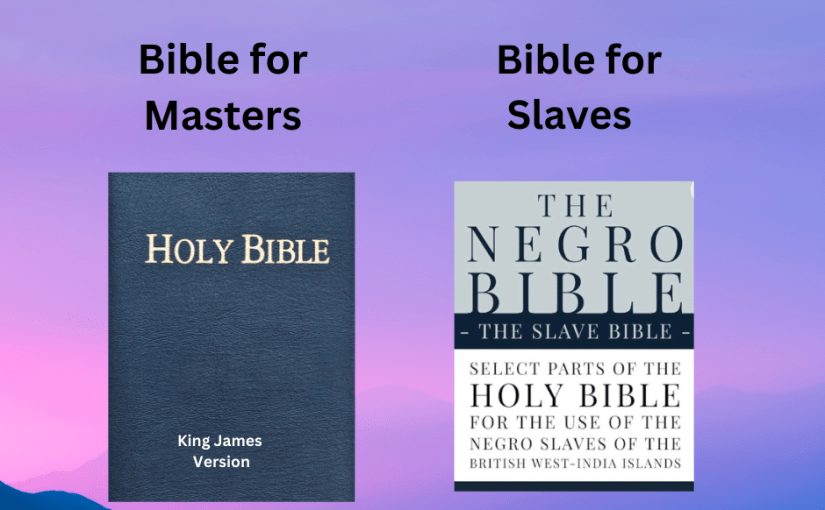
Because a bible had to be used in order to teach Christianity, a different bible was created for this dual Christianity.  

The Negro Slave Bible

In 1807 the Negro Slave Bible was published in London, printed by Law and Gilbert. It had “Select Parts of the Holy bible for the use of the Negro Slaves in the British West-India Islands.” The differences in the slave bible were:

The King James Bible has 1,189 Chapters.  The Negro Slave Bible has 232 Chapters. 

90 percent of the Old Testament was eliminated. Exodus and Jeremiah were left out because owners didn’t want the enslaved to know about Moses leading slaves to freedom.  

50 percent of the New Testament was not included. Especially, Galatians was left out because of the reference to slaves and masters being equal.

Owners needed to emphasize servitude and obedience as a divine mandate from God.  Being a good Christian would rise and fall on these two scriptures:

 Ephesians 6:5–6 (NASB)

Slaves be obedient to those who are your masters according to the flesh, with fear and trembling in the sincerity of your heart, as to Christ; not by way of eyeservice as men pleasers, but as slaves of Christ, doing the will of God from the heart.

Colossians 3:22-24 (NASB)

“Slaves, in all things obey those who are your masters on earth, not with external service, as those who merely please men, but with sincerity of heart, fearing the Lord. Whatever you do, do your work heartily as for the Lord rather than for men, knowing that from the Lord you will receive the reward of the inheritance. It is the Lord Christ whom you serve.”

How to Make a Negro Christian

In 1831 Dr. Reverend Charles Colcock Jones, a missionary and slave owner, began making a speech throughout the southern states, about why and how to teach enslaved Africans about Christianity.

In 1832 Dr. Reverend Jones published a book entitled “The Religious Instruction of the Negroes in the United States.”  It was a biproduct of the popularity of Jones’ speeches the prior year.

In the book, Reverend Jones’ extensive dehumanization of Africans was traumatizing in my just reading it. The culmination of all of the degrading vitriolic propaganda was that slaves were no good for anything except working the fields and making babies for sale.

As a result of that depiction, owners would not have to feel any guilt about the unspeakable atrocities they would commit against their “property.”

Needless to say, the Negro Slave Bible and Reverend Jones’ book, worked like a charm. This form of dual Christianity would ensure unchallenged authority over enslaved Africans into perpetuity.

Although slavery would be legally abolished on December 18, 1865, a slave mentality continues to exist.  Bodily freedom did not free some formally enslaved people’s mind, nor the minds of some of their descendants. To me, much of this propaganda of the inferiority of Black people continues within the dual forms of Christianity that exists even now.

Dual Christianity in America

We’ve already seen how the “two” bible concept represents two ways of seeing and serving God. One according to scripture and one through unmitigated tyranny.

Black people and White people may basically use the same bible; however, interpretation of scriptures may differ radically. The Bible teaches that God created all humans in His image and are deeply loved and valued equally by Him.

The White Christianity’s interpretation of scripture is the superiority of White people and the enslavement of Black people due to the curse of Noah’s son Ham (an absurd motive, devoid of biblical sanction).

Because of the level of pain and trauma associated with the dual Christianity in America, many African Americans continue to believe in God, just not Christianity. They have left the traditional church to seek inclusive spiritual spaces to heal from past traumas and to find meaning and fulfillment in spaces that offer equality, less judgment and inclusion.

Generally, African American’s interpretation of scripture is based on love, freedom and equality. Not to imply here that African American churches are perfect because they are not. The issue here is a dual Christianity, based on dual perspectives.

Dual Christian Organizations

Klu Klux Klan – a Protestant Christian Organization

On December 24, 1865, the KKK was formed in Pulaski, Tennessee.  They were white Protestants who formed an organization to terrorize, lynch, bomb churches, schools, businesses, and homes of African Americans, murdering countless men, women and children in the process. 

The KKK had huge red crosses embroidered on the front of their white robes, as they burned crosses amidst their crimes, as symbols of their Christian faith.   

Segregation of Christian Denominations

Beginning around 1870 former slaves were forced to start their own Christian churches because they were not permitted in White churches or denominations.

For instance: The White Church would be Methodist Episcopal; for former enslaved Africans, their Methodist church would be (AME) African Methodist Episcopal. This was the description for whatever denomination Black people were a part of because of segregation.

Present Day Church Segregation

Most people know that Sunday mornings are the most segregated times of the week. Even though Christians are supposed to be unified through a shared faith in Christ, it isn’t happening. 

The Church is more segregated and divided in beliefs than ever.  The White church has embraced the radicalized former republican party as divinely appointed by God. Generally, the White church continues to condone the demonization of minorities, immigrants and the poor. 

They rail against abortion and homosexuality. Yet, when it comes to racism, and oppression, many pastors say those are social issues against which they will not preach. Both are sin and social. Interestingly, abortion is not specifically addressed in the bible.  However, Jesus spoke often about the poor, oppressed and to love everyone.

America continues to operate under a dual Christianity. Segregation in so many areas whereas the Lord stressed love for one another and unity. It is as though so many Christians are living by the infamous statement Alabama Governor George Wallace made in his inaugural address on January 14, 1963, that resonates even today:

 “Segregation now! Segregation tomorrow! Segregation forever!”

In Conclusion

I believe that dual Christianity in America has forsaken the teachings of scripture for warped self-actualization and promoting a religion based on tyranny, oppression of the poor and marginalized; and is only committed to the White and wealthy.

The far-right evangelical Christians, both Black and White, have bastardized the good news of the gospel into something totally antithetical to biblical Christianity, the republican party. The exchange of the wooden cross for a shiny gold elephant is evident through all of the hate and vitriol spewed everywhere.

For this, there has been a price to pay. The overt hypocrisy of Christianity leaves a bad taste in mouths and a stench in nostrils of many unbelievers. Where there use to be respect for God, His Name and that of Jeus Christ, they are now used as curse words.

This is not because unbelievers have gotten worse, it is because so-called Christians have rejected the True and Living God, exchanging Him for a god created in their own image and an earthly savior supposedly to make America great.

I no longer self-identify as a Christian. I am a person who believes the Bible. I have read, studied it in the Hebrew and Greek, memorized, taught and tried to live according to it for many years. I am a Bible-believer, period.

Biologically There is No Such Thing as “Race” Part 2

by Cynthia Cummings-Walker
A Word to the Wise (lifeandbibleblog.com)

Deleterious Effects of a Race-based Social Construct

One time my husband was returning from a business trip where he had flown on the company’s private jet. On the way home once my husband entered our predominately White city, a police car pulled behind him. When my husband turned into the neighborhood we lived in, so did the police. When he turned into our cul de sac, the police turned in there also. Once the police saw our garage door begin to open, they circled around and left.

What a dichotomy. From private jet to suspect, all within an hour. This is not an indictment of police. It’s about a general perception of Black people who are living within a race-based social construct.  They can be perceived as guilty until proven innocent.

Because a Black person can’t have their Resume,  financial portfolio, and address clearly displayed at all times, they are generally seen as some type of menace. Problematic for some, deadly for others. 

Black people face situations daily that White people never even have had to think about. That is one reason it must seem incredulous to them when they hear certain scenarios about discriminatory practices.

Within this racially stratified culture, some White people make excuses for the mistreatment of Black people, saying they deserved it.  While other courageous White people have spoken out against racism and white supremacy.

One of the reasons I cherish my genuine White friends so much is because they know many of my experience first-hand.  They understand the plight of Black people. I never have to hear them make excuses or defend racism.   

From the wealthiest Black person to the poorest ones, they have shared experiences wherein no matter what level of education, wealth or fame achieved, Black people in society are inordinately portrayed and treated as though they are inherently genetically inferior, angry, and violent.

A Race-based social construct is very complex.  Currently, there is no easy way to dismantle it, yet there are steps that can be taken to quell its effects in the meantime.  It will have to be a journey just like so many other changes in society when people deem it so.

Personal Decisions Should Take Precedence over Other People’s Biases

I am not a victim of this Race-based social construct. I have many more advantages and opportunities than the enslaved Black people who initially came to America. They did not speak the language. They were deprived of their cultural norms. They were not permitted to learn to read or write. They were robbed of their dignity. They were treated inhumanly.

Nonetheless, freed Black people left plantations with only ragged clothes on their backs, yet with sheer brainpower, strength, courage, determination, and the help of abolitionists they survived, thrived, and excelled in every area that makes America one of the most advanced and prosperous nations in the world today. I walk in their footsteps, unfettered by obstacles and barriers.

My decisions determine how I live, not someone else’s biases. It really doesn’t matter what settings a person is born into. A person’s initial environment does not determine how their life will be lived; their decisions do. No environment guarantees failure or success. A person’s decisions determine that.

If a person is born into poverty, they don’t have to spend the rest of their lives there. They can rise above their circumstances. A basic education is free. Libraries are free. If the person excels in school, college scholarships are available which is almost free. There are mentors who can help guide a person who is tenacious and teachable. That person’s decisions will determine whether they win or lose.

On the other hand, a person born into wealth and privilege, does not have a guarantee of success. They can use their advantages wisely, or squander opportunities. They have a choice. Sadly, there are countless wealthy people who find themselves drug or alcohol addicted. Fortunately, there are all kinds of programs to help anyone with these struggles. Wealth couldn’t keep them from unnecessary pain and heartache. Better decisions could have.

I taught my children and grandchildren this concept: “Decisions Create Environment”. Their daily decisions will either give them options, or have privileges taken away. They have a choice. They must decide what they want the outcome of their actions to be now, and as adults. No matter what they are faced with, what they do about it is up to them. I pray that they always choose to overcome.

Moving Past Not being Racist to being for Anti-Racism  

I know that all White people do not embrace the ideology of superior and inferior “Races”.  They are not racist. However, in today’s society it is not enough for a person not to be racist. Another step is needed.

Some White people do not see their actions as racist because they do not say or do the obnoxious things that overtly racist people do. I understand. However, sometimes White people have an unconscious bias of which they are unaware. 

When another White person points out something that appears racist, it can be enlightening. Non-racist White people appreciate the insight when these things are brought to their attention by another White person. True racists reject the information and call, or label, the White person the opprobrious term a “N-word” lover.  

Many times, when a Black person mentions anything about racist words or actions, they are labeled as “pulling the race card”. I so appreciate the fact that my White friends understand the plight of Black people in America. They know that they have White privilege.  When necessary they use their privilege to make a difference in the lives of Black people, and others.  

I believe that one of the most effective ways a White person can help to quell overt racism is to say something. Perhaps it can make a difference and possibly lessen the humiliation a Black person may feel. I know that these acts have lessened my pain, and possibly enlighten the person who inflicted it.

Benefits of “If You See or Hear Something, Say Something”

  1. A White co-worker of mine who had recently moved to the area, attended a cocktail party where there were only White people present.  She was astonished at how freely people were using the N-word, joking about, and disparaging Black people.  When my friend couldn’t take it anymore, she raised her voice and said that her mother was Black and the conversations were very offensive. Although her mother was not Black, that was the only thing she could think of at the time to try to stop the overt racist conversation.  It did.
  2. A couple of Black friends and I were seated in a hotel restaurant for about 10 minutes without being waited on. A White couple, who came in after us, who had been waiting to be seated finally were given a booth.  Immediately the waiter went over to them to take their order. The man pointed out to the waiter that while waiting he noticed that we had been sitting there for a while without service and that the waiter should wait on us first.
  3. A White acquaintance of mine decided to be a waitress in an extremely popular restaurant in a predominantly White area where we lived.  During the training for new employees, they were told, “Don’t worry about giving Black people good service because they don’t give good tips.”  My neighbor was appalled, and asked, “If Black people get poor service, why should they leave a good tip?” She was told in so many words that Black people were not a priority there.  She walked out right then, never to return.
  4. Recently my husband and I were in a restaurant that required a reservation. We came in on time and were seated.  For about 10 minutes of watching everyone’s table being waited on except ours, and not even being able to make eye contact with a waiter, we got up to leave.  Before we could get to the door, a White Manager asked us why we were leaving.  We told her.  She asked us to return to the table and we would be waited on immediately.  She sent a waitress over that we had not seen that evening.  We received excellent service from that point on and a hefty discount.

This was an anti-racism action to me.  A teaching moment for waiters. We have been in restaurants with the same issue and no one questioned or cared if we walked out. 

White People and Black People Need to Develop Friendships

Some White people proclaim that they are not racist because they have a Black friend. For a White person to have a good relationship with a Black co-worker or neighbor does not prove that a person is not racist.  Usually, those relationships are cordial and superficial. W

I am not making a judgement here.  This is basically the American way.  When there are a couple of Black families in the neighborhood, or children in a school, that doesn’t really matter that they share the same space if they are devoid of personal relationships.

When a White person grows up in an all-White environment, lives in an all-White neighborhood, goes to all-White schools, White houses of worship in all faiths, attends all-White parties and celebrations from a child up, they have no opportunity to know Black people personally. They will primarily  rely on what they’ve been told by sources they trust.

A couple of years ago I was in an international Book club wherein we read and discussed the book “White Fragility” by Robin DiAngelo.  Robin is a White woman explaining from her own experiences why many White people perceive Black people the way they do. I learned so much from that book and diverse group discussions. 

What has been invaluable to me is White friends.  They individually have stood by me through thick and thin, and I, them. They have been true friends to me in every way.  We love each other.  My friends have gone into battles with me, encouraged me and fought for me.  They were willing to open those doors that I had no access to as a Black person.  The doors that were figuratively for “Whites only.”

A close friendship with people of diverse cultures and ethnicities is extremely important in closing the “racial” divide. I have benefited in ways that I would never have expected. Bottom line is that developing genuine personal relationships with Black people and others of diverse backgrounds can dispel myths on all sides.  Why not at least try it?

Continued in Part 3

Biologically There is No Such Thing as “Race”

Cynthia Cummings-Walker
A Word to the Wise (lifeandbibleblog.com)

Nothing Biological Identifies “Race”

God created the world in all of its beauty with its landmasses, climates, bodies of water, vegetation, forests and flowers, and every living creature. Then God created the human race. He created mankind in His own image, according to His likeness (Genesis 1:26).

Then God created people with diverse nationalities, ethnicities, cultures, skin tones, eye and hair colors and textures. What a beautiful picture of diversity. The only “Race” that God created is the human race.   

I understood this more clearly when I took a DNA test to determine my ancestry. My genome showed that my ethnicity originated from two continents – Africa and Northwestern Europe. There was no “Race” indicated.  “Race” is not identifiable in the human genome genetically or biologically, nor is it scientifically quantifiable. Something that does not exist cannot be measured.

Identifying “Race” would be like attempting to measure the miles that Santa Claus travels around the world on Christmas eve. Yes, children see Santa, sit on his lap, and tell him what they want for Christmas. They wake up on Christmas morning to open the toys Santa left. None of this proves that Santa exists. It’s merely a part of American tradition and culture which so many enjoy.

Santa Claus and “Race” have much in common. Santa Claus is beneficial to the people who embrace him, and the retailers who make billions of dollars a year off of this folklore. The designation of “Race” is advantages for those who want to perpetuate an inferior and superior grouping of people.

Think about it, biologically human bodies basically function the same way under a 2mm skin covering. If a person needs a blood transfusion there are no racial groupings. Blood is blood by type. When a person needs an organ transplant, there are no racial categories to choose from. Compatibility in blood and tissue type are requirements. “Race” is not a factor because “Race” does not exist.

Disagree?  Of course, everyone is entitled to their own opinion about Race. I’m not bothered by that. Opinions are just opinions. Facts are facts. Where opinions and facts differ is that opinions don’t have to be based on any specific science.

Facts are based on information predicated upon universal truth, scientific, genetic, and biological research, and data. The most brilliant minds in the world have not identified anything such as “Race”.  

“Race” is a Created Social Construct

Since “Race” classifications have no scientific validity, why in 21st century America does this racial designation continue to exist? There is no benefit in this created race-based construct except for those who believe in the theory of superior and inferior “Races”.

This has been exponentially the case in America since 1619.  Because a Race-based social construct has been an integral part of American society for centuries does not justify its continuance.  To quote Booker T. Washington: “A lie doesn’t become truth, wrong doesn’t become right, and evil doesn’t become good, just because it’s accepted by a majority.”  

Why in America should Black people need to check a box that says African American, indicating “Race”, on so many mundane forms if it is not required on a Driver’s License, Passport, or other official documents which are identifiers?

When Black Americans travel anywhere in the world they are classified as a citizen of the United States of America, period. Yet, here in this nation, Black people are expected to use the prefix, African.   I do not.

Furthermore, this whole idea of people of “mixed Race” being identified as Black or African American is telling.  This harkens back to the legalized “One Drop Rule” referring to hypodescent (automatic descent to the subordinate group) which was outlawed in America by the Supreme Court in 1967.

Because Black people are not monolithic, some may think “Race” designations matter. That’s okay. However, for those who see “Race” as the race-based social construct that it is, perhaps they should question the validity of the “Race” question on forms.  I have.

Not once has anyone been able to give me a valid answer as to why “Race” is important there. Some intellectual discussions about the validity of “Race” may change the narrative after a while. I have seen changes, and progress when I have raised the issue.

I think that it is important to say here that I do not consider myself to be a helpless victim of this raced-based social construct. My decisions determine how I live, not other people’s biases.

Continued in Part 2 and 3

Self-Examination Time

Lifeandbibleblog.com

by Cynthia Cummings-Walker

Self-Reflection

People are so busy these days with little time to sit in contemplative silence without their thoughts racing to the next thing.  It seems so difficult to live in the moment, or even have time for self-reflection.

“Is my life going the way I wanted it to, or am I on auto pilot stuck in a mindless routine?  Do I have specific goals of what I want to accomplish in my life and career? Am I self-aware, or just being herded along with the bustling crowd with no clear direction?”.

When we periodically take time to self-reflect, we can make mid-course corrections if necessary, or completely change direction when we find we are on the wrong path in our quest for a fulfilling life.

When a person is not self-aware, they may be making decisions that are completely unrealistic, which can have dire consequences.

One of the main areas I see this manifested is in dating, especially online dating. Although a person’s goal is to meet a potential mate, when they are not self-aware their choices can be off kilter. 

Self-Awareness is Crucial

To thine own self be true.”  William Shakespeare

Usually a person looking for a love relationship try to look for their ideal person.  They want to meet a highly successful businessperson, someone wealthy, or even a celebrity…a person who is the epitome of sophistication and physical perfection.

In online dating, many have been conned into thinking that they are communicating with their ideal person, never asking themselves these questions:    

Why would a person of that caliber need to go on a dating site when they lead lavish lifestyles, meet all kinds of successful people in business, social engagements, and travel?  

Why would an average person sitting in front of a computer looking for love think that they would be the type of person to attract someone of such “high value” when they have almost nothing in common? 

Of course there is nothing wrong with being average.  Most people are.  The issue here is the total lack of self-awareness, honest introspection, or being realistic enough to know that perhaps they are aiming too high.

Some people overlook someone who would be perfect for them, yet because the person does not meet their ideal, the potential mate is rejected. They are just not good enough.

For by the grace given me I say to every one of you: Do not think of yourself more highly than you ought, but rather think of yourself with sober judgment….” Romans 12:3 (NIV)  

Self-Deception and Denial  

Many times, it does not appear that the person doing the searching considers what they are bringing to the table.  Is it enough to justify such high standards in the person they want as a mate? 

For example, there are women who have very high standards and expectations of what they want in a man.  They will settle for nothing less. He must be 6 feet tall, earn at least 6 figures, be handsome and have an athletic body.  This type of man is considered by many to be a “high value man”.

In looking at the woman, she has no formal education, works at a fast-food restaurant, is a single mother receiving government assistance, is not concerned about eating healthy or exercising, yet believes she deserves a “high value man.”  

On the other hand, there are men who make an average salary, lives in a very modest apartment, drives a 5-year-old car, has a belly that hangs over his belt, yet he is looking for a woman who is smart, beautiful, sexy, and the embodiment of female perfection.

There is nothing wrong with the woman or man here in terms of what they look like or how they live.  The problem comes when the person is living in denial and self-deception, believing that their situation should have no bearing on the type of person they desire.

Be Realistic

I pray…..that you will keep on growing in knowledge and understanding.  For I want you to understand what really matters,….” Philippians 1:9–10 (NLT)

When people are realistic, they are reasonable in what they look for in others.  They won’t  have high expectations of others, and low standards for themselves.

When we are realistic about ourselves, we can make choices that will ultimately take us to where we want to go in life, and with whom.

On the other hand, being unrealistic can cause someone to be harmed in so many ways. People have been used and abused by those who prey upon people who live in self-denial and are not self-aware when it comes to relationships.   

Be What You Want In Others

You cannot withdraw money from a bank where you made no deposit. 

Invest in your personal growth by doing those things that will cultivate a healthy mind and body.  Strive for excellence in every area of your life. 

Read, study, travel, use the gifts and talents you have, build healthy relationships, improve your appearance without risking your life, go to therapy if you need it.  Create new habits. Leave the past in the past.  Forgive.  Love God, yourself, and others.

For I know the plans that I have for you, declares the Lord, plans for welfare and not for calamity to give you a future and a hope.”(Jeremiah 29:11)

Be prepared for what the Lord has prepared for you!

Questions for Self-Reflection

After self-examination, are there some things you need to re-evaluate or change? 

If so, what will you do to change…. lower your expectations of others, or raise your standard for yourself?

The Value of Being Perfectly Imperfect

By Cynthia Cummings-Walker

My 11-year-old granddaughter was given some coins for a game she won.  As she looked at the quarters she realized that one was very different from the others.  The face of the quarter depicted George Washington, as usual, yet the back looked unique. 

My granddaughter decided to do some research on Coin websites.  She discovered that quarters, like the one she had, could be worth as much as $1,000.00.  However, the valuable quarter had to have a specific defect which would make it valuable. 

My granddaughter’s coin was perfectly shiny but did not have a flaw.  Therefore, it was only worth the 25 cents that average quarters are valued. A coin having a specific defect is what makes it so valuable.  It had to be imperfectly perfect.

The Illusion of Perfection

In today’s society, perfection appears to be the goal as a mark of achievement or value.  Men and women will have all kinds of cosmetic procedures performed in order to have the perfect face and body.   Some have died or are disfigured as a result of underqualified, or unqualified surgeons.

Celebrities themselves have admitted that they don’t really look like their professional photos.  Makeup, lighting, editing, and filters create the mirage of beautiful, perfect, beings. It is all a façade. If actors and models were so perfect there would be no need for the entertainment industry to use extras like body doubles, and hand models.

The Value of Imperfection

Years ago there was a mold that all models had to fit into. They had to be extremely thin and as perfect looking as possible.  Sometime later,  women came along who refused to change what seemed to be imperfections so that they could become top models. 

Cindy Crawford refused to have her facial mole removed.  Margot Hemmingway refused to have the gap in her teeth corrected.  Those imperfections are what caused them to stand out in the industry and they became supermodels.

Today, the standards in the entertainment industry have changed because those who do not fit into a “model mold” are the ones sought after.  There are prominent celebrities and models who would not have had a chance in the past.

Nowadays models can have vitiligo, facial scars, a missing limb, ambulism and all kinds of physical differences that make them interesting and different.  People today want uniqueness, not uniformity.

 Who Are you Trying to Please?

So many people are discontented with their physical appearance.  If their hair is curly, they want it straight.  If their skin color is dark they want to lighten it.  If their skin color is light they want to darken it.  Some want medical procedures to shrink an area, while others want medical procedures to enlarge something.

I am certainly not attempting to judge how people feel about themselves.  My concern is for those who are preoccupied with physical perfection as though it is the gateway to success and happiness.

Plenty of people who look perfect in face and body have turned to illegal drugs or even suicide because they are so unhappy. Their inner self is not in alignment with their outward appearance. 

Many people will invest all kinds of money in how they look and what they wear yet are bankrupt in terms of cultivating an inner beauty. 

Don’t be concerned about the outward beauty of fancy hairstyles, expensive jewelry, or beautiful clothes. You should clothe yourselves instead with the beauty that comes from within,….which is so precious to God.” 1 Peter 3:3–4 (NLT)

Cultivating inner beauty, integrity and character will take a person much further in life than a pretty face with a nasty attitude. “As a ring of gold in a swine’s snout So is a beautiful woman who lacks discretion.”  Proverbs 11:22 (NASB)

 Embrace being Perfectly Imperfect

Then God said, “Let Us make man in Our image, according to Our likeness;…”  God created man in His own image, in the image of God He created him; male and female He created them.  God blessed them;…” Genesis 1:26–28a (NASB)

Everything and everyone God created is perfect because we are created in His image and likeness regardless of any “imperfections” we may see in ourselves or others.

I do not believe that God created anyone “ugly”. As the saying goes: “Beauty is in the eye of the beholder.” Standards of beauty are generally determined within ethnicities, cultures, or society; all designed and created by God.   

People can reject someone based on their own personal reasons or prejudices, yet no one can stop God’s plan for your life.  Embrace who you are because you know whose you are. Do the best you can with what you have to work with. Improve what you can and embrace the rest.

Investing time in developing and maintaining a close relationship with the Lord has earthy benefits and eternal rewards.  When you trust God by believing what He says in His word, the Bible, your life will be filled with thanksgiving, praise, and gratitude for the life He has given you, imperfections, and all.

Trust in the Lord with all your heart And do not lean on your own understanding. In all your ways acknowledge Him, And He will make your paths straight.” Proverbs 3:5–6 (NASB)

Question for Reflection:  Have you ever considered this?:

For God so loved the world, that He gave His only begotten Son, that whoever believes in Him shall not perish, but have eternal life.” John 3:16 (NASB)

Believe.  Pray.  Read the Bible.  Trust.  Obey

Age is Just a Number: Lessons from the Bible

Lifeandbibleblog.com

by Cynthia Cummings-Walker

How Old Are You?

Have you ever heard the saying, “Age ain’t nothing but a number.”? It implies that a person is only as old as they feel.  A person in their 20s can be a couch potato while a 70-year-old still runs marathons.  A younger person’s lifestyle may make them look and feel 20 years older, while an older person’s lifestyle allows them to look and feel 20 years younger.

A person’s physical age does not automatically determine their insights, strength, vitality, common sense, wisdom or how they live their life. 

The date of someone’s birth does not definitively determine their age. The death date is an indicator of how old a person really is.  If a person is only going to live until they are 25, at 20 they are old.  If a person is going to live to be 90, then at 40 they are young. 

Some people may say: “I’m too young” while others may say “I’m too old.” Neither is correct. The Bible is full of examples of how God used people of all ages to accomplish His purposes.

Never too Young

In I Samuel 2:26 “Now the boy Samuel was growing in stature and in favor both with the Lord and with men.”

In 2 Kings 5:1-3 God used a little girl, to tell Naaman, captain of the kings army,  where the prophet Elisha was, so he could get healed of leprosy. After Naaman was healed he said: “Behold now I know that there is no God in all the earth but in Israel..” 2 Kings 5:15a God was glorified through the testimony of a child.

Luke 2:41-50 tells how at 12 years old Jesus was  in the temple with the teachers, listening, asking questions.  “And all who heard Him were amazed at His understanding and His answers.” Luke 2:47  “And Jesus kept increasing in wisdom and stature, and in favor with God and men.” (vs 52).   

Never Too Old

As I looked back over my life, I had some regrets about things I did not do when I was younger.  I was thinking that I’m too old.  I don’t have the strength or stamina I had when I was young. My mind is not as sharp as it used to be.  I’ve been through too much.  It’s too late. 

My excuses were contrary to how Scripture addresses the issue of age.  There are many things in life that have to fit into an age category.  God’s promises have no age requirements or limits.    

Moses was 80 years old when he led the Israelites out of Egypt; “Moses was 120 years old when he died, yet his eyesight was clear, and he was as strong as ever.” Deuteronomy 34:7 (NLT)

Sarah was extraordinarily beautiful as an older woman who had to dissuade powerful men from trying to take her away from her husband.  Genesis 12:11.  Sarah also had extraordinary faith. Hebrews 11:11

Anna, a widowed prophetess, was 84 years old and still serving in the temple with fasting and prayers night and day. Luke 2:36–37.

Caleb –I am eighty-five years old today. I am still as strong today as I was in the day Moses sent me; as my strength was then, so my strength is now, for war and for going out and coming in.” Joshua 14:10–11 (NASB)

 Lydia – a businesswoman and worshipper of God (Acts 16:14-15) who believed the gospel message, she and her household were saved.  She invited the disciples to stay at her home.

What do these Young and Old Have in Common?

They lived by faith and obedience to God.  Like the rest of us, they had trials and tribulations, failures and successes.  What makes the difference in being spiritually productive throughout life is being devoted to the Lord in worship, prayer and obedience to His word.

Are You Prepared for your Number to be Called?

Because we don’t know how old we really are, Psalm 90:12 (KJV) tells humanity: “So teach us to number our days, That we may apply our hearts unto wisdom.

For God so loved the world that He gave His only Son, that whoever believes in Him shall not perish, but have eternal life. For God did not send the Son into the world to judge the world, but that the world might be saved through Him.” John 3:16-17 (NASB)