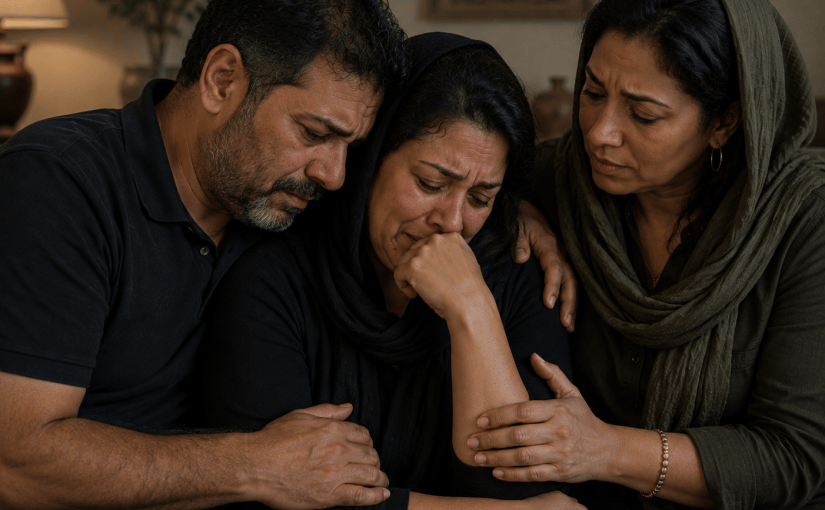
10 Things You Can Say or Do to Help A Parent Who is Grieving

Cynthia Cummings-Walker, Lifeandbibleblog.com

When Someone’s Child Has Passed Away

When learning of someone’s child death, knowing what to say or do can be confusing or downright scary.  That is completely understandable.

I’m sure that people want to help or comfort the grieving parents.  Yet, because they are unsure of what to do or say, they may end up saying or doing something that is hurtful instead of helpful.

I know from personal experience. Hopefully something here will ease some discomfort in interacting with a parent who is grieving.

When My Child Passed Away

“I  loved Rachel from the very first beat of her heart, and I will love her until the last beat of mine.”

As I sat at my daughter’s bedside and watched her chest move up and down, slower, and slower until it stopped altogether, my precious Rachel was gone.

Then the physician came into the room and placed the stethoscope on her chest.  He nodded and verified, yes, she had passed away. No!!!!!!!! This wasn’t right. This wasn’t fair.

Even though I knew for about three days that this was coming, the reality of it all left me in shock. It was all so surreal.  As I looked down on Rachel’s beautiful peaceful face, I had to acknowledge it. She was gone, never to return.

It was like I was in nightmare that I couldn’t wake up from.

A Parent’s Worst Nightmare

A child passing away is in a completely different category than a parent, sibling, spouse, relative or friend who dies. Of course it hurts and loved ones grieve. The pain and loss is different when someone’s child passes away.

This is not the way the world is designed to function.  Children are supposed to outlive their parents. Right? I felt like the normal cycle of life had somehow malfunctioned and I was outliving my child. It all seemed so unfair.

2 Very Important Things to Remember

People wanted to comfort me. Some helped and some caused hurt. Not deliberately. They just didn’t know what to do or say. Here are a couple of things to realize right from the start:

  • There is nothing that can be said or done to fix the situation. Their child is gone, never to return.
  • The amount of contact you have with the parents should be in line with how well you knew them before their child passed away.

10 Things You Can Say or Do That Can Help Parents Whose Child Passed Away.

  1.  Formulate a plan.
  2. The fewer the words, the better.  There is less of a chance to hurt or offend: Saying “I’m so sorry for your loss.” or “I love you.” or “I’m praying for you.” can be comforting.
  3. Hugs can help if appropriate.  Gestures can speak louder than words.
  4. Take cues from the parents. Give the parent space until they feel comfortable enough to communicate.
  5. When visiting, keep the visit short.
  6. Be an attentive listener. Some parents want to talk about their child without interruption or unsolicited advice. It’s difficult just listening, yet it can help.
  7. Sending flowers, cards and notes can let a parent know that you care and are thinking about them.
  8.  Take or send something to the grieving family. Examples: a meal, finger foods, fruit, paper cups, plates, napkins, tissue, bottled water, or anything else you may think of.
  9. Order a meal from a restaurant and have it delivered to their home.
  10. Do something special to memorialize their child. Example: Someone gave me a small figurine of a little girl angel. It reminded me of my daughter and meant a lot to me. Be creative if you want to do something special.

In Conclusion

Kind and thoughtful words and actions can go a long way in trying to comfort grieving parents. There is no timetable for how long a parent will grieve. Don’t believe the “stages of grief ” scenario. Grief has no timetable or end date.

There is no such thing as someone “getting over” their child passing away. We learn to move forward in life, focusing on what remains rather than what has been lost.

My thoughts and prayers are with you all, the grievers and those who are trying to comfort.

Please feel free to comment, or give other suggestions on what can comfort a parent whose child has passed away.

Transforming Grief: From ‘Why’ to ‘What Can I Do?’

Lifeandbibleblog.com

by Cynthia Cummings-Walker

When I was given the bad news, at first I was in shock. All kinds of thoughts swirled around in my head.  I took a few deep breaths to calm the torrent of tears and confusion. I needed to be able to think clearly.  Decisions had to be made, but first I wanted to know “Why?” Why did my child die when so many others in the same situation lived?

Of course, I wouldn’t want anyone else’s loved one to die, I just wanted to know why mine didn’t live. I couldn’t help but compare myself to others who received miracles in hopeless situations.  Against all odds, some people survived when death was imminent, or an illness deemed incurable was cured. Why didn’t this happen in my case?  Not getting a miracle just like so many others wasn’t fair.  

Through a veil of excruciating pain and bitter tears I asked the “Why?” question over and over.  I prayed and pleaded for God to let me know why.  I believed that if the “Why” questions were answered, I would understand. Yet, to my chagrin, God remained silent. 

I was livid!  I was angry with people because of their actions or inaction.  I was angry with myself.  Perhaps if I had done something different this wouldn’t have happened. I was mad at everyone.  I was behaving as though mere mortals have the power of life and death in their hands.  Only God has that power. I was angry with Him too. Why didn’t He stop this from happening?

Would Knowing “Why” Change What Happened?

Eventually something dawned on me…if the “Why” questions were answered, and the results remained the same, knowing “Why” wouldn’t change a thing. My child would still be dead.  Knowing “Why” was useless. It had no pain relief attached to it.

This tragedy had left me feeling like I had fallen into a deep, dark pit. “Why” would not be the rope or ladder lifting me out.  My thought process had to change if I wanted to have peace. Demanding answers had gotten me nowhere.  I decided to ask the Lord for direction. Kind of “Not My will but Thine be done.

This opened-minded approach to dealing with tragedy would allow me to know what God wanted to do, verses what I wanted Him to do. Because the Bible is God’s primary communication to us, I turned there for clarity.

One day while reading I came across a story that made me look at my condition in a completely different light.   In John 5:5-9 there is a story of a man who had been ill for thirty-eight years.  When Jesus saw him lying on a mat,.. Jesus “said to him, Do you want to be made well?” What a strange question to ask someone who is incapacitated?  Even odder was the fact that the man didn’t say yes. Instead he said ““Sir, I have no man to put me into the pool when the water is stirred up; but while I am coming, another steps down before me.” (NKJV)  

I don’t know whether the man asked for help and was rejected, or whether he  didn’t ask anyone for help,  assuming that no one would want to help him. Whatever his reasoning, blaming others was getting him nowhere. The question Jesus asked, and the response from the infirmed man was not much different than mine back then.  

Was I remaining in this emotional pit because I was failing to do what it took to get out?  Was it easier for me to blame others, rather than taking responsibility for what I needed to do for myself to be healed? 

This self-examination prompted me to look deeper into my attitude and actions. Did I really want my broken heart healed?  Did I feel that if I tried to move forward enjoying life again, others might think that I didn’t really love my daughter? 

My identity had become the grieving mother. I had gotten comfortable being paralyzed by pain and making excuses for why I wasn’t moving forward. Even though the man on the mat did not say he wanted to be healed, Jesus healed him anyway.  The same for me.

Exchange the “Why” for “What Can I Do Now?”

“Why” would have to go and take its bitterness and despair with it.  “What” would take its place. I wondered what specific things I could do to move forward in life. I read books about people who used their pain and misfortunes to help others.  Some started organizations or support groups; dedicated playgrounds or planted trees in honor of their loved one. Others impacted lives by being a friend or mentor to someone who is struggling.  There are myriads of positive things that can be done.     

Getting out of that dark pit of despair into the world of possibilities changed my life exponentially.  As I heard the uplifting stories from others, and shared mine, my outlook on life brightened. My depression lifted. I didn’t have to feel guilty about enjoying life.  I was doing something worthwhile; something that in the long run honored my child.

“What” pulled me out of the pit of despair onto a seat of power.  Not power in the sense that I was anyone special.  The power was the ability to be a part of a process that would affect people’s lives for the better.

“What” took the focus off of me and placed it on to others. I had renewed strength and vitality. I felt an energy I hadn’t experienced in years.  I could genuinely laugh and smile again. It was amazing.  Whenever I felt sad, I would rebound quicker.

Are you stuck on the “Why” merry-go-round, always moving but going nowhere?  Do you really want to be well?  If so, there is hope. When you are ready to reach out to others, the small piece of rope you are barely holding on to can be transformed into a lifeline for someone who is sinking. None of this happens overnight, yet it can happen.

If you decide to exchange the “Why” for the “What” it can be transformative, taking you from debilitating pain to a renewed sense of hope and purpose.  Take the risk.  You may surprise yourself with the positive impact you can have on others. You just have to take it one step at a time.

Questions for Reflection

Are there positive things you can see that have come out of your tragedy?

Do you want to get well? If not, why do you think you should live in a perpetual state of grief and loss?