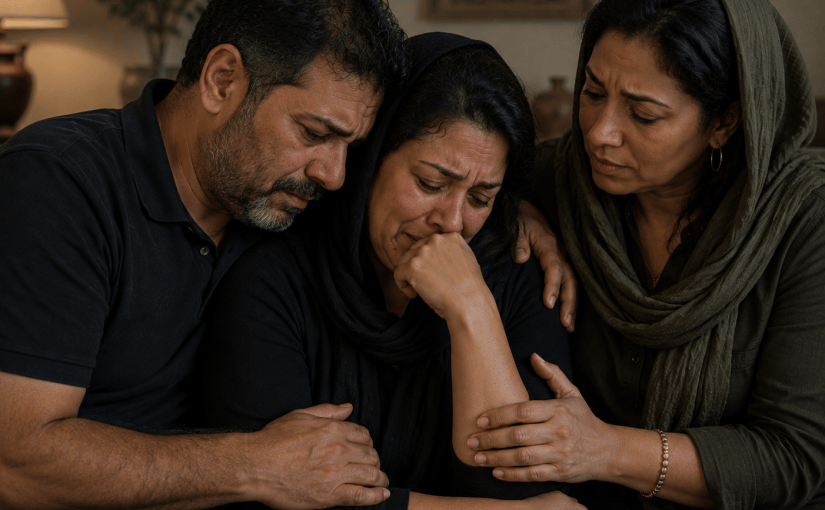
10 Things You Can Say or Do to Help A Parent Who is Grieving

Cynthia Cummings-Walker, Lifeandbibleblog.com

When Someone’s Child Has Passed Away

When learning of someone’s child death, knowing what to say or do can be confusing or downright scary.  That is completely understandable.

I’m sure that people want to help or comfort the grieving parents.  Yet, because they are unsure of what to do or say, they may end up saying or doing something that is hurtful instead of helpful.

I know from personal experience. Hopefully something here will ease some discomfort in interacting with a parent who is grieving.

When My Child Passed Away

“I  loved Rachel from the very first beat of her heart, and I will love her until the last beat of mine.”

As I sat at my daughter’s bedside and watched her chest move up and down, slower, and slower until it stopped altogether, my precious Rachel was gone.

Then the physician came into the room and placed the stethoscope on her chest.  He nodded and verified, yes, she had passed away. No!!!!!!!! This wasn’t right. This wasn’t fair.

Even though I knew for about three days that this was coming, the reality of it all left me in shock. It was all so surreal.  As I looked down on Rachel’s beautiful peaceful face, I had to acknowledge it. She was gone, never to return.

It was like I was in nightmare that I couldn’t wake up from.

A Parent’s Worst Nightmare

A child passing away is in a completely different category than a parent, sibling, spouse, relative or friend who dies. Of course it hurts and loved ones grieve. The pain and loss is different when someone’s child passes away.

This is not the way the world is designed to function.  Children are supposed to outlive their parents. Right? I felt like the normal cycle of life had somehow malfunctioned and I was outliving my child. It all seemed so unfair.

2 Very Important Things to Remember

People wanted to comfort me. Some helped and some caused hurt. Not deliberately. They just didn’t know what to do or say. Here are a couple of things to realize right from the start:

  • There is nothing that can be said or done to fix the situation. Their child is gone, never to return.
  • The amount of contact you have with the parents should be in line with how well you knew them before their child passed away.

10 Things You Can Say or Do That Can Help Parents Whose Child Passed Away.

  1.  Formulate a plan.
  2. The fewer the words, the better.  There is less of a chance to hurt or offend: Saying “I’m so sorry for your loss.” or “I love you.” or “I’m praying for you.” can be comforting.
  3. Hugs can help if appropriate.  Gestures can speak louder than words.
  4. Take cues from the parents. Give the parent space until they feel comfortable enough to communicate.
  5. When visiting, keep the visit short.
  6. Be an attentive listener. Some parents want to talk about their child without interruption or unsolicited advice. It’s difficult just listening, yet it can help.
  7. Sending flowers, cards and notes can let a parent know that you care and are thinking about them.
  8.  Take or send something to the grieving family. Examples: a meal, finger foods, fruit, paper cups, plates, napkins, tissue, bottled water, or anything else you may think of.
  9. Order a meal from a restaurant and have it delivered to their home.
  10. Do something special to memorialize their child. Example: Someone gave me a small figurine of a little girl angel. It reminded me of my daughter and meant a lot to me. Be creative if you want to do something special.

In Conclusion

Kind and thoughtful words and actions can go a long way in trying to comfort grieving parents. There is no timetable for how long a parent will grieve. Don’t believe the “stages of grief ” scenario. Grief has no timetable or end date.

There is no such thing as someone “getting over” their child passing away. We learn to move forward in life, focusing on what remains rather than what has been lost.
My thoughts and prayers are with you all, the grievers and those who are trying to comfort.

Please feel free to comment, or give other suggestions on what can comfort a parent whose child has passed away.

Navigating Grief on Mother’s Day

Cynthia Cummings Walker. Lifeandbibleblog.com

Mother’s Day was designed to be a happy day to celebrate mothers with cards, flowers, dining out, phone calls and texts. So, why would Mother’s Day bring so much grief to some. It’s simplistic and it’s complicated.

When my daughter passed away I didn’t think I could ever celebrate another holiday again, especially not Mother’s Day. The thought of it was heart wrenching. I was not supposed to outlive my child. After all, isn’t that supposed to be the natural cycle of life? Yet, not for me, nor for many of you.

Grief and loss filled the space which once brought such joy and happiness to me.

I struggled. I tried to appear cheerful as my sons celebrated me as their mother. As time passed, I realized I didn’t have to pretend to be ecstatic over all of the cards and gifts. It didn’t have to be gloom and doom either.

I searched for ways that would help me have a balanced approach to celebrations. I learned that laughing and having fun was not disrespectful to the memory of my daughter. When I felt like shedding a tear, there was no need to apologize for that either. It is all bittersweet since my beloved Rachel passed away.

Many Situations Can Cause a Person to Hurt on Mother’s Day.

A mother or child has passed away.

A mother may still be alive, yet dementia has robbed her of any meaningful contact or memory. A daughter lost her mother long before her mother passed away. It was a slow, aching grief that did not culminate when her mom breathed her last breath. The grief process continues.

A woman who longed to be a mother, yet was never able to conceive or adopt grieves the loss of what never was. Wanting to be a mother and being denied the opportunity is devastating while so many other women’s motherhood is celebrated.

Sometimes the grief comes because of the loss of a loved one who was a mother figure. Genetics does not equal family. Sometimes a non-relative can be closer than any blood relative.

A person may be estranged from their mother, or child, for many reasons. However, that reality does not take away the pain of not having a relationship, and being able to celebrate a natural bond that has been broken.

Have any of these situations, or others, cause you to feel hurt on Mother’s Day?

8 Things that Can Be Done When Mother’s Day Hurts

There are no pat answers about what to do, or not do when Mother’s Day brings pain. I’ve learned not to focus on what I’ve lost. Rather plan and make the best of what remains.  The following are ideas.

  1. Look at photographs or other memorabilia depicting happier times that can bring a laugh, or comfort you.
  2. If your mother or child has passed away, shed tears if you must, don’t feel guilty or think you have to be strong for others in order to not rain on their parade.
  3. Get together with people who understand what you are going through and will support you.
  4. Create traditions that will distract from the specific celebration of the day.
  5. Don’t trust everything depicted on social media as though everyone, except you, are thoroughly enjoying the day.
  6. Try to focus on what you do have versus concentrating on what is missing in your life.
  7. Try not to take the failings of others personally on Mother’s Day.  Sometimes people’s actions are not necessarily about you.  It could be about what they are dealing with that has nothing to do with you. 
  8. Try different things to see what works for you. When you do, perhaps you can pass ideas along that can help others to have a more pleasant Mother’s Day.

Praying that you will have a happier Mother’s Day this year and always!